Old Mammoth: Where Mammoth Lakes Began
Old Mammoth sits at the southern end of town along Old Mammoth Road, running roughly from Mammoth Creek Park toward the Bluffs. It feels quieter and more residential than the Village or Main Street, with a mix of older cabins, mid-century homes, and newer houses tucked among the pines and firs. Mammoth Creek winds through parts of the area, and the neighborhood still carries the sense of being the place where everything started.
The Original People and the First Boom
Long before any mining claims or roads, the Paiute (sometimes spelled Piute) lived and hunted across this part of the Eastern Sierra. They moved seasonally through the valley and surrounding mountains, using the creeks, meadows, and higher elevations for food, trade, and shelter.
European American settlement arrived with the search for gold. In 1877, four prospectors looking for the legendary Lost Cement Mine staked claims on Mineral Hill (now often called Red Mountain) south of present-day town along what became Old Mammoth Road. The following year, General George Dodge of San Francisco bought up many of those claims and formed the Mammoth Mining Company. He built a substantial 20 stamp mill, tunnels, and a tramway. Word spread fast. By the summer of 1878, roughly a thousand people had arrived; the next year the number climbed closer to 1,500. A rough mining camp called Mammoth City (sometimes associated with Mill City) sprang up. Saloons, boarding houses, and supply stores appeared almost overnight.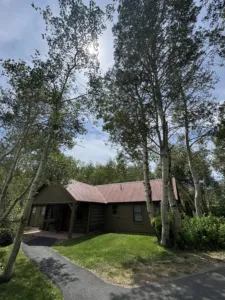
The boom was short lived. The ore proved weaker than hoped, winters were brutal, and the company shut down in 1880. A large fire that November burned through much of the settlement. By the late 1880s only a handful of people remained. Stone foundations and a historical marker near the upper end of Old Mammoth Road still mark the old townsite.
From Mining Camp to Mountain Resort
After the gold rush faded, the focus shifted downhill toward the meadows along Mammoth Creek. In the early 1900s the area that became known as Old Mammoth (or simply Mammoth) developed as a quiet logging and tourism outpost. Charles F. Wildasinn built a hotel, cabin, store, and sawmill. Power for the hotel came from a Knight water wheel that had originally driven the mining stamp mill. The heavy cast iron wheel was later moved to its present location near Old Mammoth Road, where it generated electricity for the growing resort. One of the early log cabins still stands nearby.
In 1918 Charlie Summers bought most of the Wildasinn buildings and created Mammoth Camp, a simple hotel and rooming house with corrals and cabins. A fire in 1927 destroyed much of it, but the neighborhood continued to grow slowly. By the 1930s a handful of businesses and cabins remained. Highway 203’s completion in 1937 pulled most commercial activity northward to the modern town center, leaving Old Mammoth more residential.
What You Find Today
Walk or drive the streets; North, Connell, Sherwin, Tamarack, Sunny Slopes, Mill, Red Fir, and others and you still see traces of that layered past. Some original log cabins survive. The Knight water wheel sits beside the bike path as a quiet reminder of the industrial beginnings. Nearby, the Mammoth Museum at Hayden Cabin (a 1920s–1930s hunting and fishing lodge built by Emmett and Margaret Hayden) offers exhibits on Native American life, the mining years, early tourism, and the town’s later growth. Mammoth Creek Park and the surrounding meadows make easy places to stop and take in the setting.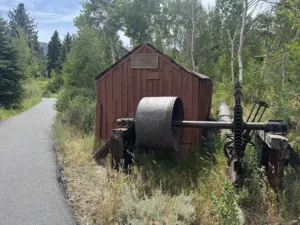
Old Mammoth remains primarily residential. Locals value the relative calm, the forested lots, and the sense of history. Snowcreek Athletic Club and the nearby golf course sit at the edge of the neighborhood, but commercial activity is limited until you reach the lower end of Old Mammoth Road near the park and the restaurant row that has developed over the years.
If you are looking for a neighborhood that feels rooted in the actual beginnings of Mammoth Lakes rather than the later ski town boom, Old Mammoth delivers. It is the place where the Paiute lived for generations, where miners briefly chased gold in the late 1870s, and where the first modest resorts took shape along the creek. The cabins, the creek, the old wheel, and the quiet streets still carry that story.